> For the complete documentation index, see [llms.txt](https://docs.umbraco.com/llms.txt). Markdown versions of documentation pages are available by appending `.md` to page URLs; this page is available as [Markdown](https://docs.umbraco.com/umbraco-cloud/begin-your-cloud-journey/creating-a-cloud-project/baselines.md).
# Baselines
Use Baselines to quickly create new Umbraco Cloud projects using pre-made schema and setup.
A Baseline project is similar to a fork (forked repository) on GitHub. A clone of an existing project is created while maintaining a connection between the two projects. The connection exists between the Live environment of the **Baseline project** and the left-most mainline environment of the **Child project**.
Any project can act as a Baseline project.
The idea is that you have a project containing all your standard Umbraco packages and components. Some default Document Types that you want to use as a baseline for future projects are also configured. When you've made changes to your Baseline project, you can push them out to all the Child projects with a click of a button.

## Create a Child Project
To create a Child project from a Baseline, follow these steps:
1. Log in to the [Umbraco Cloud Portal](https://www.s1.umbraco.io/projects).
2. Click the **Create Project** button.
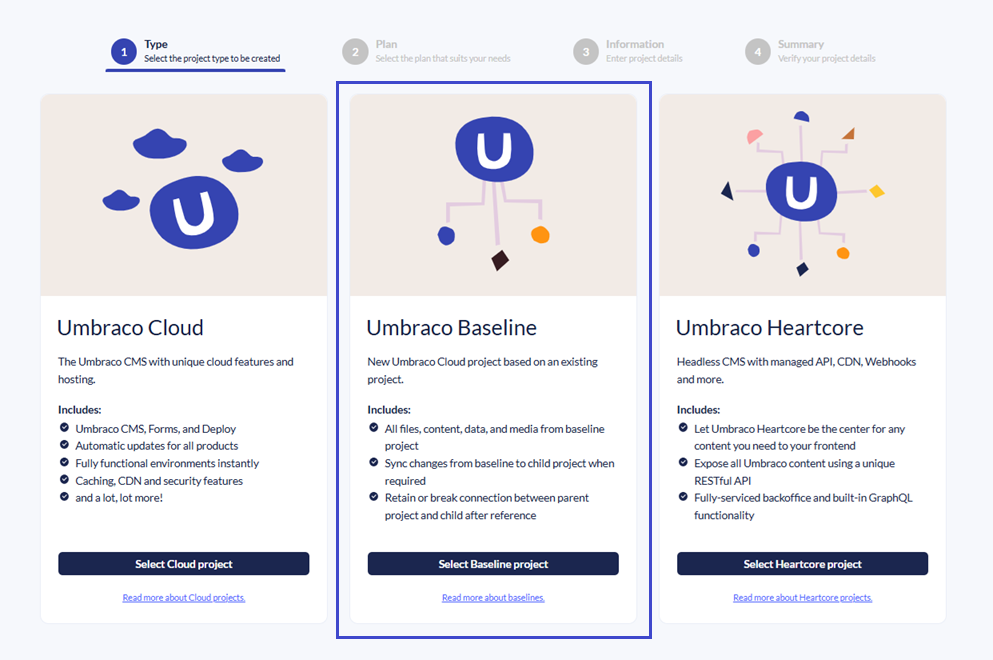
3. Click **Select Baseline project**.
Select Baseline Project
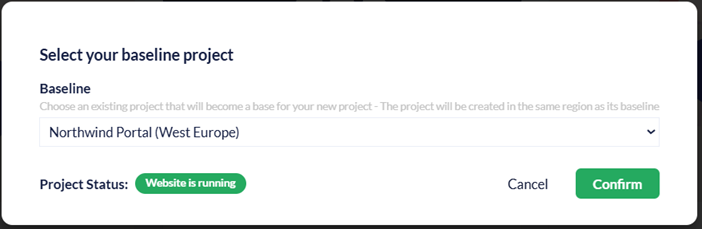
4. Use the dropdown to choose an existing project to use as the baseline.
Choose an existing project that will become a base for your new project
5. Click **Confirm**.
6. Choose a **Plan** for the project.
7. Enter the **Project Name**.
8. **Choose an Owner** from the drop-down list.
9. Fill in the required **Technical Contact** information.
10. Click **Continue**.
11. Review the **Summary** of the information provided.
12. Select **I have read and agree to the terms and conditions and the Data Processing Agreement**.
13. Click **Create Project**.
{% hint style="info" %}
The Child project creation time depends on the size of the Baseline project.
{% endhint %}
### Restore content from the Baseline project
When you've created the Child project, you can restore content from the Baseline project:
1. Go to the newly created project.
2. Click **Backoffice**.
3. Go to the **Content** section.
4. Click **...** next to the **Content** tree.
5. Select **Environment Restore**.
6. Ensure **Baseline** is selected in the dropdown as the source environment.
7. Click **Restore from Baseline**.
If you do not see the content, reload the content tree once the restore is complete.
## Related articles
{% content-ref url="/pages/eBYzmWa3FkjLx4ispOSk" %}
[Manage Baseline Children](/umbraco-cloud/build-and-customize-your-solution/handle-deployments-and-environments/manage-baseline-children.md)
{% endcontent-ref %}
{% content-ref url="/pages/2V7exveJLy77dkbA1Kx4" %}
[Pushing Upgrades to a Child Project](/umbraco-cloud/optimize-and-maintain-your-site/monitor-and-troubleshoot/resolve-issues-quickly-and-efficiently/baseline-merge-conflicts/upgrading-child-projects.md)
{% endcontent-ref %}
{% content-ref url="/pages/ElbaEH8TFUPraQntnpcG" %}
[Handling configuration files](/umbraco-cloud/optimize-and-maintain-your-site/monitor-and-troubleshoot/resolve-issues-quickly-and-efficiently/baseline-merge-conflicts/configuration-files.md)
{% endcontent-ref %}
{% content-ref url="/pages/oB1uYBsVV6ZPxfGxTFgg" %}
[Baseline Merge Conflicts](/umbraco-cloud/optimize-and-maintain-your-site/monitor-and-troubleshoot/resolve-issues-quickly-and-efficiently/baseline-merge-conflicts.md)
{% endcontent-ref %}
---
# Agent Instructions
This documentation is published with GitBook. GitBook is the documentation platform designed so that both humans and AI agents can read, navigate, and reason over technical content effectively. Learn more at gitbook.com.
## Querying This Documentation
If you need additional information that is not directly available in this page, you can query the documentation by asking a question.
Perform an HTTP GET request on the following URL with the `ask` and `goal` query parameters:
```
GET https://docs.umbraco.com/umbraco-cloud/begin-your-cloud-journey/creating-a-cloud-project/baselines.md?ask=&goal=
```
`ask` is the immediate question: it should be specific, self-contained, and written in natural language.
`goal` is what the user is ultimately trying to achieve, the reason they need the answer. Sharing it helps GitBook give you a better, more relevant answer. A goal is most helpful when it describes the outcome the user wants rather than restating the question. For example, with `ask=how do I create an API token`, a goal like `automate deployments from our CI pipeline` lets GitBook tailor the answer to that use case.
The response will contain a direct answer to the question and relevant excerpts and sources from the documentation.
Use this mechanism when the answer is not explicitly present in the current page, you need clarification or additional context, or you want to retrieve related documentation sections.