> For the complete documentation index, see [llms.txt](https://docs.umbraco.com/llms.txt). Markdown versions of documentation pages are available by appending `.md` to page URLs; this page is available as [Markdown](https://docs.umbraco.com/umbraco-cms/13.latest/fundamentals/data/defining-content/default-document-types.md).
# Default Document Types
On this page, you will find the default Document Types in Umbraco. If you want to use these document types, you can create them in the Settings section.
## Document type with template
Creating document types with templates allows you to define both the content structure and the visual presentation of a particular type of content item. It ensures a consistent and cohesive look and feel across your website while also enabling structured content management. This approach helps separate content from design, making it easier to manage and update your website's content and appearance independently through templates.
## Document type
Creating a Document Type (without a template) is about defining the content structure and fields that can be used across different content items. You might use document types without templates for creating consistent, structured content that doesn't require a predefined page layout. For example blog posts or product listings.
## Compositions
Compositions provide a way to create reusable sets of properties that can be added to one or more document types. This can help simplify the management and consistency of content types across your website.
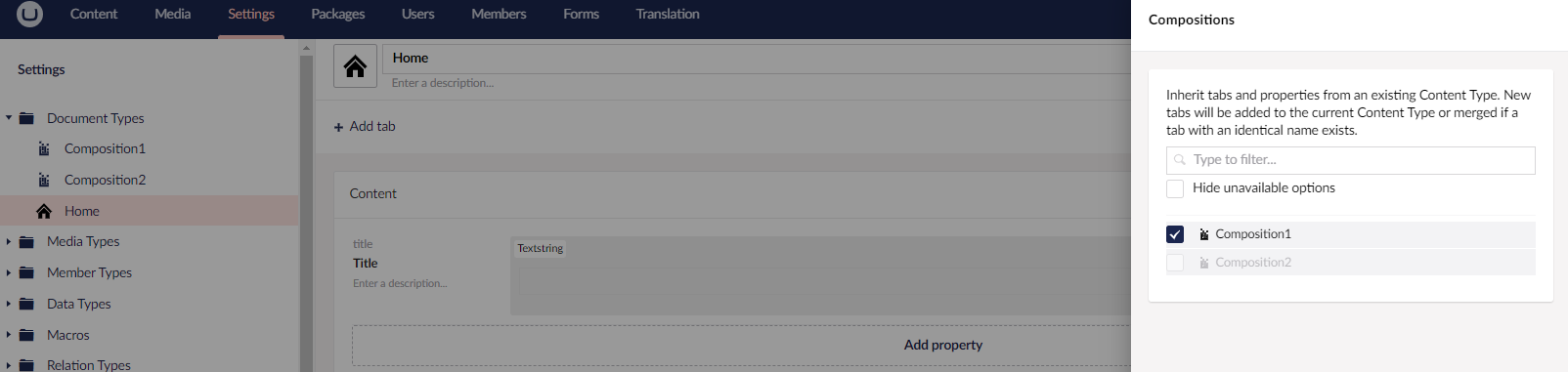
When using a mixed setup, you can take advantage of nesting and use compositions by clicking on "**Compositions**..." option.
{% hint style="warning" %}
If you create 2 compositions that contain some common properties it is only possible to pick one of the compositions in a Document Type. If preferred, those compositions that cannot be used can be marked as hidden by checkmarking the `Hide unavailable options`.
{% endhint %}
## Element Type
An Element Type is a Document Type without a template containing schema configurations for repeating a set of properties. These are for defining schema in the Block List Editor, Block Grid Editor, or other Element Type based editors.
Element Types cannot be used to create content that resides in the Content tree. When you create an Element type, it automatically sets the **Is Element Type** flag to **True** on the **Permissions** tab.
Element Types are created using the same workflow as regular Document Types but usually contain fewer properties. You can also create Element Types as part of configuring a Block Grid or Block List Data Type.
---
# Agent Instructions
This documentation is published with GitBook. GitBook is the documentation platform designed so that both humans and AI agents can read, navigate, and reason over technical content effectively. Learn more at gitbook.com.
## Querying This Documentation
If you need additional information that is not directly available in this page, you can query the documentation by asking a question.
Perform an HTTP GET request on the following URL with the `ask` and `goal` query parameters:
```
GET https://docs.umbraco.com/umbraco-cms/13.latest/fundamentals/data/defining-content/default-document-types.md?ask=&goal=
```
`ask` is the immediate question: it should be specific, self-contained, and written in natural language.
`goal` is what the user is ultimately trying to achieve, the reason they need the answer. Sharing it helps GitBook give you a better, more relevant answer. A goal is most helpful when it describes the outcome the user wants rather than restating the question. For example, with `ask=how do I create an API token`, a goal like `automate deployments from our CI pipeline` lets GitBook tailor the answer to that use case.
The response will contain a direct answer to the question and relevant excerpts and sources from the documentation.
Use this mechanism when the answer is not explicitly present in the current page, you need clarification or additional context, or you want to retrieve related documentation sections.


 {% endhint %}
## Element Type
An Element Type is a Document Type without a template containing schema configurations for repeating a set of properties. These are for defining schema in the Block List Editor, Block Grid Editor, or other Element Type based editors.
Element Types cannot be used to create content that resides in the Content tree. When you create an Element type, it automatically sets the **Is Element Type** flag to **True** on the **Permissions** tab.
{% endhint %}
## Element Type
An Element Type is a Document Type without a template containing schema configurations for repeating a set of properties. These are for defining schema in the Block List Editor, Block Grid Editor, or other Element Type based editors.
Element Types cannot be used to create content that resides in the Content tree. When you create an Element type, it automatically sets the **Is Element Type** flag to **True** on the **Permissions** tab.
