> For the complete documentation index, see [llms.txt](https://docs.umbraco.com/llms.txt). Markdown versions of documentation pages are available by appending `.md` to page URLs; this page is available as [Markdown](https://docs.umbraco.com/contributing/documentation/getting-started/pull-request.md).
# Submit a Pull Request
Learn the two different ways to submit a PR to the Umbraco Documentation.
You can contribute to the Umbraco Documentation by submitting a Pull Request (PR). A PR is a way to suggest changes to an open-source project, such as fixing errors, improving readability, or adding new content.
There are two ways to create a PR:
1. Edit a file directly on GitHub.
2. Create a fork of the GitHub repository.
{% hint style="info" %}
You need a GitHub account to create a Pull Request.
{% endhint %}
## Option 1: Creating a PR directly on GitHub
You can submit a PR directly from our [repository](https://github.com/umbraco/UmbracoDocs/). You can also use the button on the right side of every article title. This allows you to jump straight into the file on GitHub and suggest your changes.
Following the approach is recommended for changes such as:
* Fixing typos or grammar mistakes.
* Changes that are confined to a single article.
* Updating code snippets.
Highlighting the Edit on GitHub button.
1. Navigate to the article you want to edit.
2. Select "Edit on GitHub" from the right side of the article.
3. Select the :pen\_ballpoint: icon to start editing the article.
4. Make the changes.
5. Add a commit message describing what you changed.
6. Select **Propose changes**.
7. Fill in the required information in the PR description.
8. Select **Create pull request** to submit the PR.
{% hint style="info" %}
Are you working on a larger update that includes pictures and editing multiple files? Create a fork and follow the approach outlined in [Option 2: Creating a PR through a fork](#option-2-creating-a-pr-through-a-fork).
{% endhint %}
## Option 2: Creating a PR through a Fork
The second option to submit a PR is by using a fork of the Umbraco Documentation repository. This method requires more initial setup but lets you reuse your fork for future contributions.
Following the approach is recommended for changes such as:
* Writing new articles or guides.
* Adding updates that affect multiple articles.
* Applying an update that needs to be added to multiple versions.
There are a lot of great tutorials available online on [how to fork a repository (GitHub)](https://help.github.com/articles/fork-a-repo/).
{% hint style="info" %}
If you do not have Git installed on your machine, follow [these instructions](https://help.github.com/articles/set-up-git/) before moving on.
{% endhint %}
### Step 1: Creating a Fork
1. Ensure Git is installed on your machine.
2. Go to the [Umbraco Documentation repository](https://github.com/umbraco/UmbracoDocs/).
3. Select **Fork** in the top-right corner to create a personal copy of the repository.

Once the fork is created:
1. Clone your fork to your local machine.
2. Make your changes in a local branch.
3. If you add a new article, update the `SUMMARY.md` file to include it in the documentation navigation.
4. Sync your changes back to your fork.

{% hint style="info" %}
If you’ve had your fork for a while, sync it with the original repository before starting new changes. This process is called rebasing.
{% endhint %}
To sync via command line:
* Set the original repository (UmbracoDocs) as an upstream to sync from.
* Fetch the updates.
* Update your own fork.
```console
git remote add upstream https://github.com/umbraco/UmbracoDocs/
git fetch upstream
git rebase upstream/main
```
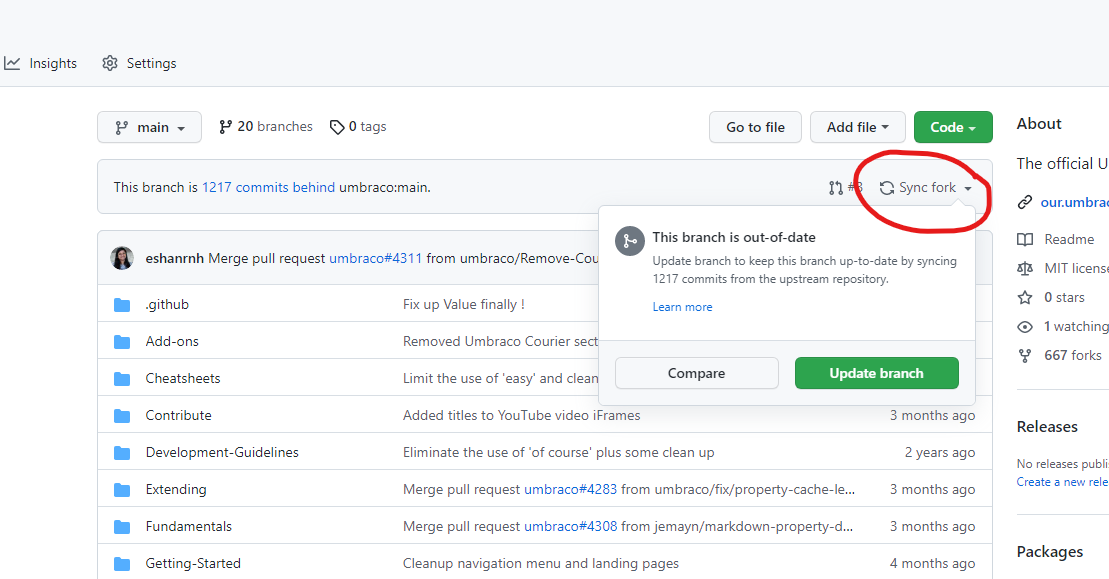
To sync via GitHub:
* Use the **Sync fork** option when your fork is behind the original repository.
### Step 2: Creating a PR
Once you have made changes and are happy with the result, you can create a PR.
1. Navigate to the **Code** section of your fork.
2. Select **Contribute** > **Open pull request**.

3. Add a title and description explaining your changes.
4. Select **Create pull request** to submit a PR to the original repository.
### Step 3: The Review Process
Your PR will be reviewed by the documentation team at Umbraco HQ.
Review times can vary based on the size and complexity of the contribution—from a few minutes to several weeks.
---
# Agent Instructions
This documentation is published with GitBook. GitBook is the documentation platform designed so that both humans and AI agents can read, navigate, and reason over technical content effectively. Learn more at gitbook.com.
## Querying This Documentation
If you need additional information that is not directly available in this page, you can query the documentation by asking a question.
Perform an HTTP GET request on the following URL with the `ask` and `goal` query parameters:
```
GET https://docs.umbraco.com/contributing/documentation/getting-started/pull-request.md?ask=&goal=
```
`ask` is the immediate question: it should be specific, self-contained, and written in natural language.
`goal` is what the user is ultimately trying to achieve, the reason they need the answer. Sharing it helps GitBook give you a better, more relevant answer. A goal is most helpful when it describes the outcome the user wants rather than restating the question. For example, with `ask=how do I create an API token`, a goal like `automate deployments from our CI pipeline` lets GitBook tailor the answer to that use case.
The response will contain a direct answer to the question and relevant excerpts and sources from the documentation.
Use this mechanism when the answer is not explicitly present in the current page, you need clarification or additional context, or you want to retrieve related documentation sections.
.png?alt=media)