> For the complete documentation index, see [llms.txt](https://docs.umbraco.com/llms.txt). Markdown versions of documentation pages are available by appending `.md` to page URLs; this page is available as [Markdown](https://docs.umbraco.com/umbraco-cms/13.latest/fundamentals/setup/install/install-umbraco-with-vs-code.md).
# Install using Visual Studio Code
Follow these steps to set up an Umbraco project with Visual Studio Code. The benefit of using Visual Studio Code is that it is super quick to get up and running.
## Installing and setting up Visual Studio Code
1. Go to and download Visual Studio Code for free.
2. Once installed, launch Visual Studio Code.
3. Click the extensions menu at the bottom on the left side. Then search for **C#** and install it.

## Creating your Umbraco project
Follow the [Templates Guide](/umbraco-cms/13.latest/fundamentals/setup/install/install-umbraco-with-templates.md) to create your project folder.
## Configure Visual Studio Code to run the Umbraco project
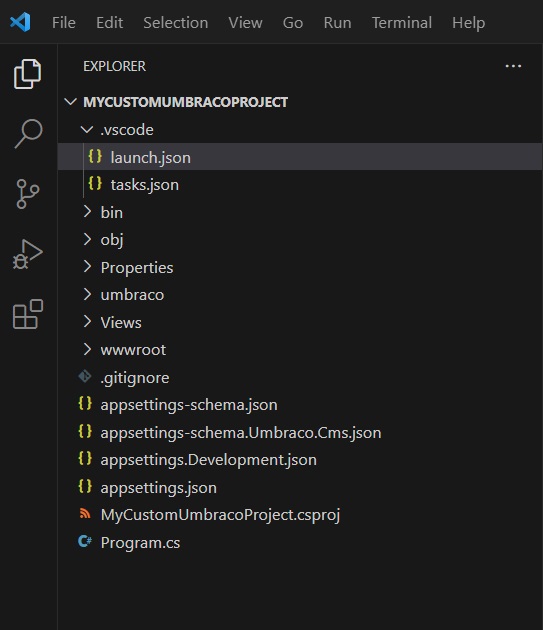
Open your project folder in Visual Studio Code, your project will look something like this:

Now we need to tell Visual Studio Code how to run your project.
Open the command palette, you can use the shortcut `Ctrl+Shift+P`, and type in `Tasks: Configure` and select the `Tasks: Configure Task` option:

Select "Create task.json from template"

Now select ".NET Core" as your template.

Visual Studio Code creates a folder called `.vscode` that contains a file called `tasks.json`. The `tasks.json` file tells Visual Studio Code how to build your project.
Now that we've told Visual Studio Code how to build your project, we need to tell it how to launch it. Visual Studio Code can do this for you. First, select the little play button in the left side menu, and then select the "create a launch.json file" link.

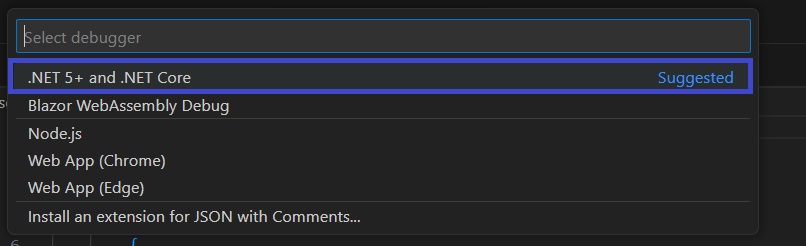
This will prompt a menu to appear, select **.NET 5+ and .NET Core**:
Prompt Menu
{% hint style="info" %}
If **.NET 5+ and .NET Core** is missing in the drop-down menu:
1. Press **Ctrl + Shift + P** (on Windows/Linux) or **Cmd + Shift + P** (on macOS) to open the Command Palette.
2. Search for the command `.NET: Generate Assets for Build and Debug`.\
This command will generate the necessary assets for building and debugging your .NET application.
{% endhint %}
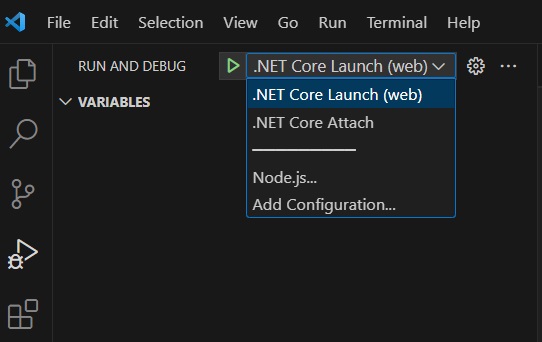
Now you'll see a green play button appear with a dropdown where ".NET Core Launch (web)" is selected.
Green Play button options
If you navigate to the Files section, a new `launch.json` file is created in the `.vscode` folder. When you press F5, the `launch.json` file tells Visual Studio Code to build your project, run it, and then open a browser .
With that, you're ready to run the project! Press F5, or click the little green play button in the **Run and Debug** section to run your brand new Umbraco site locally.
## Umbraco Web Installer
This section covers the installation and configuration of Umbraco inside your web browser when you run Umbraco for the first time.
You will see the install screen where you will need to fill in some data before Umbraco can be installed.

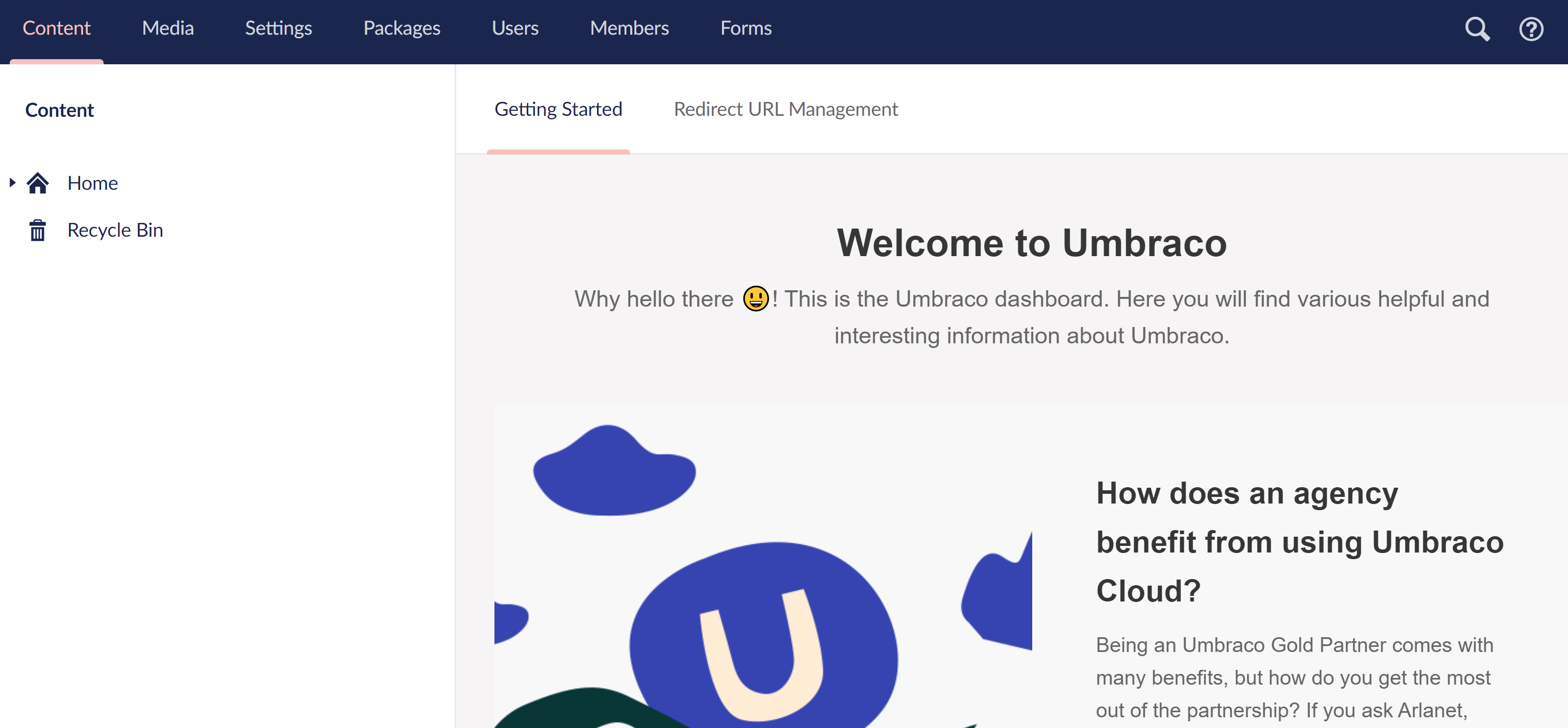
When the installer is done, you will be logged into the backoffice.
Congratulations, you have installed an Umbraco site!
{% hint style="info" %}
You can log into your Umbraco site by entering the following into your browser: `http://yoursite.com/umbraco/`.
{% endhint %}
---
# Agent Instructions
This documentation is published with GitBook. GitBook is the documentation platform designed so that both humans and AI agents can read, navigate, and reason over technical content effectively. Learn more at gitbook.com.
## Querying This Documentation
If you need additional information that is not directly available in this page, you can query the documentation by asking a question.
Perform an HTTP GET request on the following URL with the `ask` and `goal` query parameters:
```
GET https://docs.umbraco.com/umbraco-cms/13.latest/fundamentals/setup/install/install-umbraco-with-vs-code.md?ask=&goal=
```
`ask` is the immediate question: it should be specific, self-contained, and written in natural language.
`goal` is what the user is ultimately trying to achieve, the reason they need the answer. Sharing it helps GitBook give you a better, more relevant answer. A goal is most helpful when it describes the outcome the user wants rather than restating the question. For example, with `ask=how do I create an API token`, a goal like `automate deployments from our CI pipeline` lets GitBook tailor the answer to that use case.
The response will contain a direct answer to the question and relevant excerpts and sources from the documentation.
Use this mechanism when the answer is not explicitly present in the current page, you need clarification or additional context, or you want to retrieve related documentation sections.