> For the complete documentation index, see [llms.txt](https://docs.umbraco.com/llms.txt). Markdown versions of documentation pages are available by appending `.md` to page URLs; this page is available as [Markdown](https://docs.umbraco.com/umbraco-cms/extend-your-project/backoffice-extensions/extending-overview/extension-types/header-apps.md).
# Header Apps
Place single-purpose extensions in the top-level navigation bar, next to the user profile avatar.
Header App extensions appear next to the user profile and the global search icon in the top right of Umbraco’s Backoffice. Extension authors can create custom header apps to add globally accessible functionality to the Backoffice.
Header Apps
## Button Header Apps as a link
Extension authors can create header apps that link to resource both inside and outside the backoffice. Header apps can be created using a manifest or using TypeScript.
To create a link-style header app, define a `headerApp` extension in the `umbraco-package.json` file. Be sure to include `meta.label` and `meta.icon` so that your header app appears when you reload the backoffice.
If `meta.href` is defined, the header app will function as a link. Links will open in the same tab.
Header Apps can also be created using TypeScript. Examples of both approaches are shown below.
{% tabs %}
{% tab title="Using the Package Manifest" %}
{% code title="umbraco-package.json" %}
```json
{
"$schema": "../../umbraco-package-schema.json",
"name": "My Package",
"version": "0.1.0",
"extensions": [
{
"type": "headerApp",
"alias": "My.HeaderApp",
"name": "My Header App",
"kind": "button",
"meta": {
"label": "Hello Umbraco",
"icon": "icon-hearts",
"href": "https://umbraco.com/"
}
}
]
}
```
{% endcode %}
{% endtab %}
{% tab title="Using TypeScript" %}
{% code title="my-element.ts" %}
```typescript
import { umbExtensionsRegistry } from '@umbraco-cms/backoffice/extension-registry';
const manifest: UmbExtensionManifest = {
type: "headerApp",
alias: "My.HeaderApp.Documentation",
name: "My Documentation Header App",
kind: "button",
meta: {
label: "Hello Documentation",
icon: "icon-addressbook",
href: "https://docs.umbraco.com/"
}
};
umbExtensionsRegistry.register(manifest);
```
{% endcode %}
{% endtab %}
{% endtabs %}
## Button Header Apps with deeper interactivity
Extension authors can also create header apps that have more interactivity than a link.
By creating a custom component, extension authors can control how the button renders itself and how it behaves when clicked. This allows header apps to control navigation, open modals, or perform other actions.
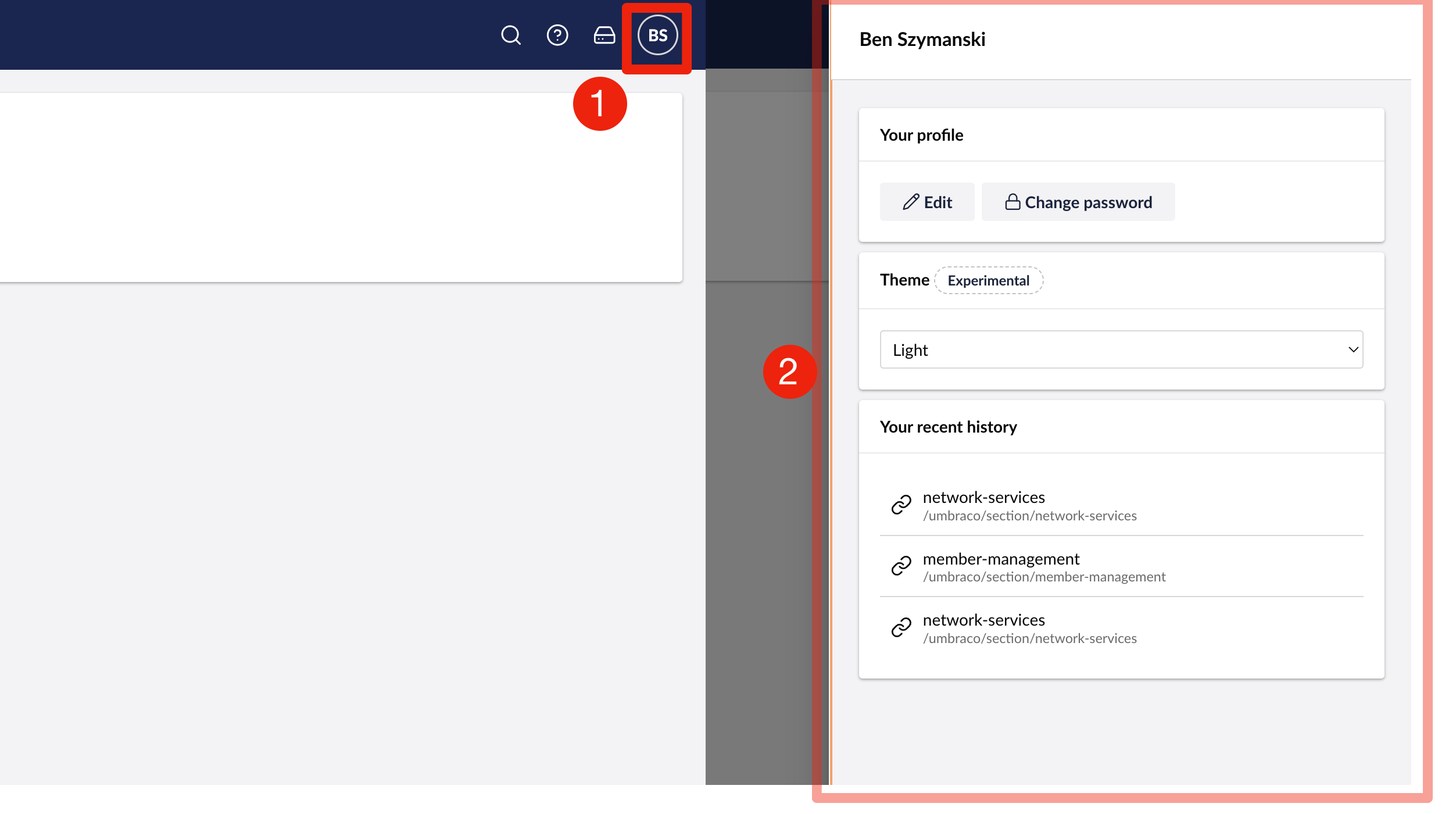
For example, this is how the current user header app is able to present a modal when clicked.
The current user modal is presented from a header app
In order for a header app to have some functionality, extension authors will need to define behavior by creating a JavaScript or TypeScript component. Once the component has been created, it will need to be registered in the header app's `element` property.
{% tabs %}
{% tab title="Package Manifest" %}
{% code title="umbraco-package.json" %}
```json
{
"$schema": "../../umbraco-package-schema.json",
"name": "My Package",
"version": "0.1.0",
"extensions": [
{
"type": "headerApp",
"alias": "My.HeaderApp.ServerServices",
"name": "My Server Services Header App",
"kind": "button",
"element": "/App_Plugins/MyPackage/server-services-header-app.js"
}
]
}
```
{% endcode %}
{% endtab %}
{% tab title="TypeScript" %}
This example assumes that the extension author has transpiled the above TypeScript code into a JavaScript file. The name and location of the transpiled file should match the `element` property in the package manifest.
{% code title="src/server-services-header.ts" lineNumbers="true" %}
```typescript
import { html, customElement } from "@umbraco-cms/backoffice/external/lit";
import { UmbHeaderAppButtonElement } from "@umbraco-cms/backoffice/components";
import { umbOpenModal, UMB_CONFIRM_MODAL } from "@umbraco-cms/backoffice/modal";
@customElement("my-server-services-header-app")
export class MyServerServicesHeaderAppElement extends UmbHeaderAppButtonElement {
async #handleUserClick() {
umbOpenModal(this, UMB_CONFIRM_MODAL, {
data: {
headline: "Would you like to disable all Server Services?",
content:
"This action can be undone, but only after all services have stopped.",
color: "danger",
confirmLabel: "Disable all services",
},
})
.then(() => {
console.log("User has approved");
})
.catch(() => {
console.log("User has rejected");
});
}
override render() {
return html`
`;
}
}
export { MyServerServicesHeaderAppElement as element };
```
{% endcode %}
{% endtab %}
{% endtabs %}
---
# Agent Instructions
This documentation is published with GitBook. GitBook is the documentation platform designed so that both humans and AI agents can read, navigate, and reason over technical content effectively. Learn more at gitbook.com.
## Querying This Documentation
If you need additional information that is not directly available in this page, you can query the documentation by asking a question.
Perform an HTTP GET request on the following URL with the `ask` and `goal` query parameters:
```
GET https://docs.umbraco.com/umbraco-cms/extend-your-project/backoffice-extensions/extending-overview/extension-types/header-apps.md?ask=&goal=
```
`ask` is the immediate question: it should be specific, self-contained, and written in natural language.
`goal` is what the user is ultimately trying to achieve, the reason they need the answer. Sharing it helps GitBook give you a better, more relevant answer. A goal is most helpful when it describes the outcome the user wants rather than restating the question. For example, with `ask=how do I create an API token`, a goal like `automate deployments from our CI pipeline` lets GitBook tailor the answer to that use case.
The response will contain a direct answer to the question and relevant excerpts and sources from the documentation.
Use this mechanism when the answer is not explicitly present in the current page, you need clarification or additional context, or you want to retrieve related documentation sections.